BMR calculator: how many calories you burn at rest
Your basal metabolic rate (BMR) is the energy your body needs just to keep running, before you move a muscle. Enter your sex, age, height and weight to see it, worked out with two equations. It updates as you type.
What is BMR?
Basal metabolic rate is the number of calories your body burns in 24 hours at complete rest: to breathe, pump blood, keep your temperature steady, run your brain and repair cells. For most people it's the biggest part of the calories they burn each day, about 60–70%.
What affects it:
- Body size: a taller, heavier body uses more energy.
- Muscle: muscle uses more energy at rest than fat.
- Age: BMR goes down slowly with age, partly because muscle mass falls.
- Sex: men usually have a higher BMR, because on average they're larger and have more muscle.
The equations
Mifflin-St Jeor (1990)
Women: BMR = 10 × weight (kg) + 6.25 × height (cm) − 5 × age − 161
Men: BMR = 10 × weight (kg) + 6.25 × height (cm) − 5 × age + 5
This is the equation the Vegochef app uses. Reviews have found it the most accurate of the common equations for healthy adults. If you'd rather not say your sex, the calculator uses the average of the two (−78).
Harris-Benedict, revised (1984)
Women: BMR = 447.593 + 9.247 × weight (kg) + 3.098 × height (cm) − 4.330 × age
Men: BMR = 88.362 + 13.397 × weight (kg) + 4.799 × height (cm) − 5.677 × age
The older Harris-Benedict equation is still widely used. It usually gives a slightly higher number. The difference between the two shows how much any estimate can vary.
An example
A 35-year-old woman, 165 cm (5 ft 5 in) tall, weighing 65 kg (143 lb):
Mifflin-St Jeor: 10 × 65 + 6.25 × 165 − 5 × 35 − 161 ≈ 1,345 kcal a day
Harris-Benedict: 447.593 + 9.247 × 65 + 3.098 × 165 − 4.330 × 35 ≈ 1,410 kcal a day
From BMR to the calories you eat
You burn more than your BMR, because you move. Multiply your BMR by an activity factor to get your total daily energy expenditure (TDEE):
| Activity level | Factor |
|---|---|
| Mostly sitting: desk job, little exercise | 1.2 |
| Lightly active: walks or light exercise 1–3 days a week | 1.375 |
| Active: exercise 3–5 days a week | 1.55 |
| Very active: hard training 6–7 days a week or a physical job | 1.725 |
The result card shows all four. For the full picture, including calories for your goal, use the TDEE calculator. Want to lose weight? The calorie deficit calculator shows how much to eat and roughly how long it takes.
Frequently asked questions
What is BMR?
BMR (basal metabolic rate) is the number of calories your body burns at complete rest in a day, just to keep you alive: breathing, circulation, keeping warm and repairing cells. It's usually 60–70% of all the calories you burn.
What is a normal BMR?
For most adult women it's roughly 1,200–1,500 kcal a day, and for most adult men 1,500–1,900 kcal, depending on size, age and body composition. Taller, heavier and younger people, and people with more muscle, have a higher BMR.
What's the difference between BMR and TDEE?
BMR is what you burn at rest. TDEE (total daily energy expenditure) adds everything you do on top: walking, work, exercise and digesting food. TDEE is the number to eat to keep your weight stable.
Which BMR formula is most accurate?
For healthy adults, reviews have found the Mifflin-St Jeor equation to be the most accurate of the common equations, within about 10% of measured values for most people. That's why the Vegochef app uses it. Harris-Benedict tends to give slightly higher numbers.
Should I eat less than my BMR to lose weight?
Not for long periods without medical advice. Eating below your BMR makes it hard to get enough protein, vitamins and minerals. A deficit from your TDEE, not your BMR, is the usual approach: see the calorie deficit calculator.
Can I increase my BMR?
Building muscle through strength training raises it a little, because muscle uses more energy than fat at rest. Getting enough protein helps keep muscle, especially while losing weight.
From calories to meals you'll enjoy
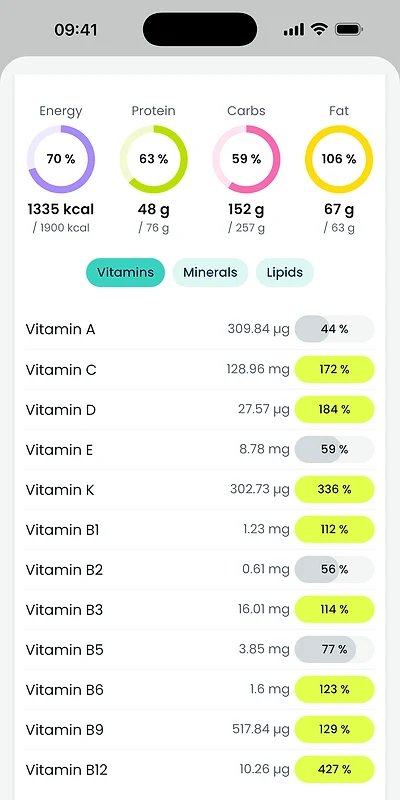
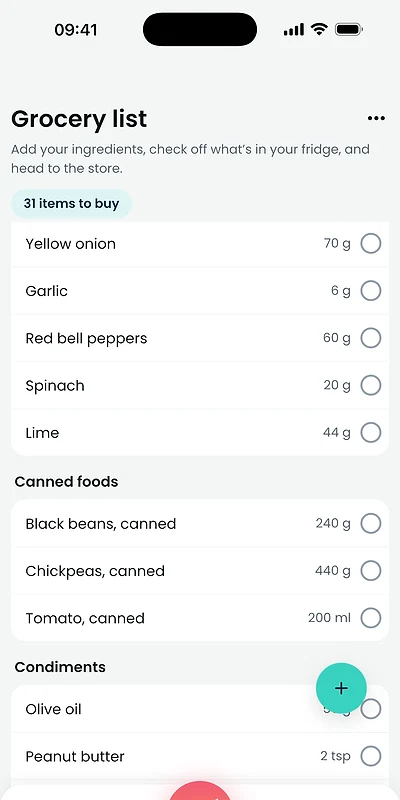
Vegochef turns your calorie and macro targets into a plant-based week, and tracks 29 vitamins, minerals and lipids alongside them.
Try it free for 7 days
Sources
- Mifflin MD, St Jeor ST et al. A new predictive equation for resting energy expenditure in healthy individuals. American Journal of Clinical Nutrition, 1990.
- Roza AM, Shizgal HM. The Harris Benedict equation reevaluated: resting energy requirements and the body cell mass. American Journal of Clinical Nutrition, 1984.
- Frankenfield D et al. Comparison of predictive equations for resting metabolic rate in healthy nonobese and obese adults: a systematic review. Journal of the American Dietetic Association, 2005.