Calorie deficit calculator: how much to eat to lose weight
Find your daily calories for weight loss at a gentle, steady or faster pace, how much you can expect to lose each week, and roughly how long it takes to reach your goal weight. It updates as you type.
How the calorie deficit calculator works
- Your maintenance calories (TDEE): your basal metabolic rate from the Mifflin-St Jeor equation, times your activity factor. See the BMR calculator and TDEE calculator for details.
- Your deficit: a percentage of your TDEE, depending on the pace you choose.
- Your expected loss: the daily deficit × 7, divided by about 7,700 kcal per kilogram (3,500 kcal per pound) of body weight.
- Time to your goal: the weight to lose divided by the weekly loss, if you enter a goal weight.
"Steady" (20% below TDEE) is the same setting the Vegochef app uses for the "Lose weight" goal.
Choosing your pace
| Pace | Calories | Good for |
|---|---|---|
| Gentle | TDEE − 10% | Small changes, the last few kilos, or if you're very active |
| Steady | TDEE − 20% | Most people: noticeable progress you can keep up |
| Faster | TDEE − 25% | Short periods, with plenty of protein; harder to stick to |
If the result is below your BMR, the calculator warns you. A slower pace is easier to keep up, and it helps you keep muscle.
An example
A 35-year-old woman, 165 cm (5 ft 5 in), 65 kg (143 lb), lightly active, choosing a steady pace:
TDEE = 1,345 × 1.375 ≈ 1,850 kcal a day
Steady deficit: 1,850 × 0.8 ≈ 1,480 kcal a day (370 kcal less)
Expected loss: 370 × 7 ÷ 7,700 ≈ 0.3 kg (0.7 lb) a week at first
Why weight loss slows down
The 7,700 kcal rule is a good starting point, but real weight loss isn't a straight line. As you get lighter, your body burns fewer calories, and it adapts a little to eating less. Early on, you may also lose water, which makes the first week look faster than it is. Recalculate after every 5 kg (10 lb) or so, and judge progress by your trend over 2–3 weeks, not single days.
Making a deficit easier on a plant-based diet
- Build meals around protein and fibre. Lentils, beans, chickpeas, tofu and vegetables fill you up for relatively few calories. See high-protein vegan meals and high-protein vegetarian meals.
- Watch the calorie-dense extras. Oils, nuts, nut butters, cheese and sweet drinks are healthy in the right amounts but add up fast.
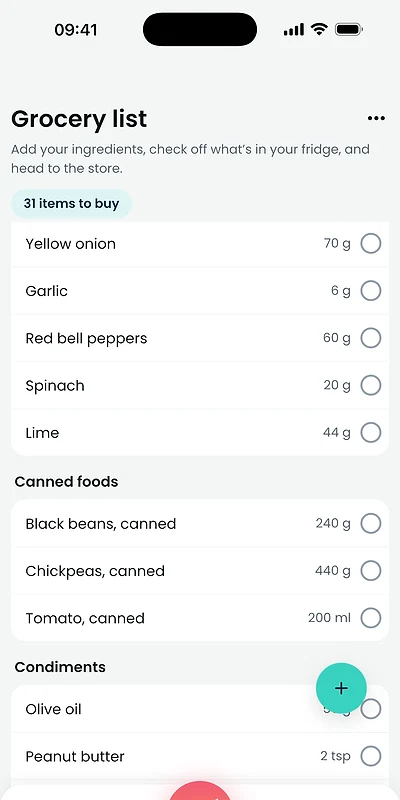
- Plan your week. Deciding meals in advance, and shopping from a grocery list, removes most of the guesswork.
- Hit your protein target to keep muscle: about 1.6 g per kg of body weight. The protein calculator shows yours.
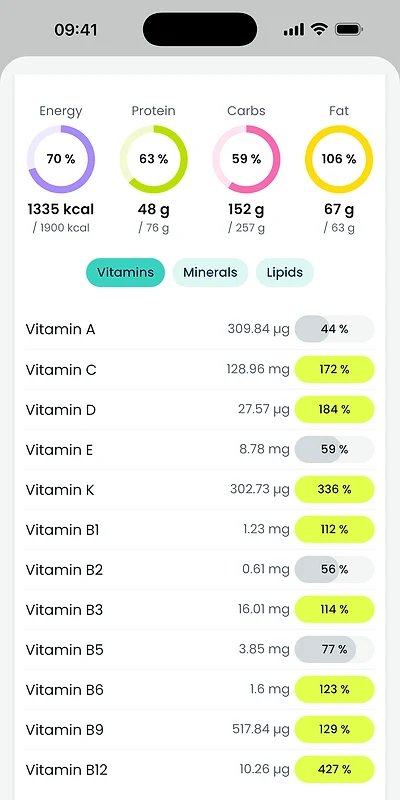
- Keep an eye on vitamins and minerals. Eating less means less room for nutrients like iron, calcium and vitamin B12.
Frequently asked questions
What is a calorie deficit?
A calorie deficit means eating fewer calories than your body burns in a day (your TDEE). Your body makes up the difference from its energy stores, mainly body fat, so you lose weight over time.
How big should my calorie deficit be?
A deficit of about 10–20% of your maintenance calories is a common, sustainable range, roughly 300–500 kcal a day for many adults. Bigger deficits work faster but are harder to keep up and make it harder to keep muscle and get enough nutrients.
How much weight will I lose with a 500 calorie deficit?
About 0.5 kg (1 lb) a week at first, using the rule of thumb that a kilogram of body fat holds about 7,700 kcal (3,500 kcal per pound). Weight loss usually slows over time, because a lighter body burns fewer calories.
Why am I not losing weight in a calorie deficit?
Water, salt and hormonal changes can hide fat loss for a week or two, so look at your weight trend over 2–3 weeks. If it really isn't moving, your activity or portions may differ from what you think: lower your calories by another 100–200 kcal a day, or move a bit more.
What is the minimum I should eat?
Don't eat below your BMR for long periods without medical advice. Very low calorie diets (under about 800 kcal a day) should only be done with medical supervision.
How do I keep muscle while in a deficit?
Eat enough protein, about 1.6 g per kg of body weight a day, and do some strength training. The calculator shows your protein target. On a plant-based diet, lentils, beans, tofu, tempeh, seitan, and for vegetarians eggs and Greek yogurt, make it easy.
Eat less without missing out
Vegochef plans plant-based meals for your calorie target and keeps an eye on protein and 29 vitamins, minerals and lipids while you eat less.
Try it free for 7 days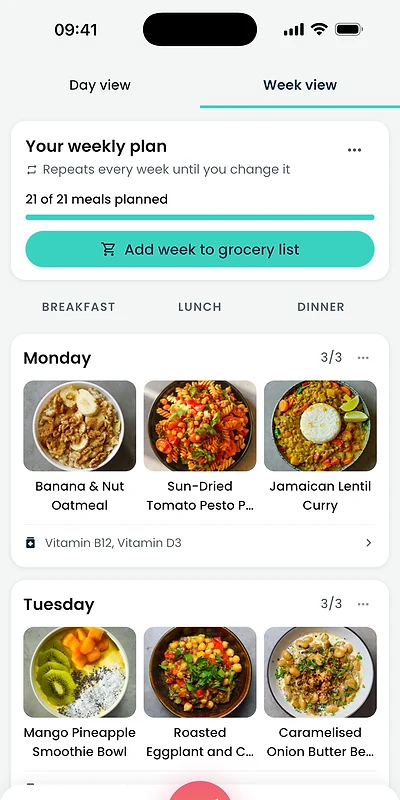
Sources
- Mifflin MD, St Jeor ST et al. A new predictive equation for resting energy expenditure in healthy individuals. American Journal of Clinical Nutrition, 1990.
- Hall KD et al. Quantification of the effect of energy imbalance on bodyweight. The Lancet, 2011.
- National Institute of Diabetes and Digestive and Kidney Diseases (NIDDK): Body Weight Planner and weight-loss guidance (niddk.nih.gov).