TDEE calculator: how many calories do you burn?
Your total daily energy expenditure (TDEE) is how many calories you burn in a day, and how many you can eat to keep your weight the same. Enter a few details to see your TDEE, your BMR and the calories for your goal. It updates as you type.
What is TDEE?
TDEE stands for total daily energy expenditure: every calorie your body uses in 24 hours. It has three parts:
- Basal metabolic rate (BMR): the energy to keep you alive at rest, such as breathing, circulation and keeping warm. For most people it's 60–70% of the total.
- Activity: everything from walking to the bus and standing at work to training. This part varies the most between people.
- Digesting food: about 10% of what you eat is used to digest it.
Eat about your TDEE and your weight stays stable. Eat less and you lose weight; eat more and you gain.
How the calculator works
First it estimates your BMR with the Mifflin-St Jeor equation, which reviews have found to be the most accurate of the common equations for healthy adults. Then it multiplies your BMR by an activity factor. It's the same calculation the Vegochef app uses when you set up your targets.
Women: BMR = 10 × weight (kg) + 6.25 × height (cm) − 5 × age − 161
Men: BMR = 10 × weight (kg) + 6.25 × height (cm) − 5 × age + 5
TDEE = BMR × activity factor
If you'd rather not say your sex, the calculator uses the average of the two equations (−78 instead of −161 or +5).
Activity factors
| Activity level | What it means | Factor |
|---|---|---|
| Mostly sitting | Desk job, little exercise | 1.2 |
| Lightly active | Walks or light exercise 1–3 days a week | 1.375 |
| Active | Exercise 3–5 days a week | 1.55 |
| Very active | Hard training 6–7 days a week or a physical job | 1.725 |
Most people overestimate how active they are. If you're unsure between two levels, pick the lower one.
Calories for your goal
- Lose weight: 20% below your TDEE.
- Maintain: your TDEE.
- Gain weight or build muscle: 10% above your TDEE, with more protein for muscle. See the macro calculator and protein calculator.
An example
A 35-year-old woman who is 165 cm (5 ft 5 in) tall, weighs 65 kg (143 lb) and is lightly active:
BMR = 10 × 65 + 6.25 × 165 − 5 × 35 − 161 = 1,345 kcal
TDEE = 1,345 × 1.375 ≈ 1,850 kcal a day
To lose weight: 1,850 × 0.8 ≈ 1,480 kcal a day
Getting the most from your number
- Treat it as a starting point. Equations can be off by about 10% for an individual.
- Track for 2–3 weeks. Weigh yourself a few times a week at the same time of day and look at the trend, not single days.
- Adjust in small steps. If your weight moves differently than you want, change your daily calories by 100–200 kcal.
- Recalculate as you change. After about 5 kg (10 lb) of weight change, or when your activity changes.
- Mind the quality, not just the number. The same calories from beans, whole grains, vegetables, nuts and seeds bring fibre, vitamins and minerals that refined foods don't.
Frequently asked questions
What is TDEE?
TDEE (total daily energy expenditure) is the number of calories you burn in a day: your basal metabolic rate (BMR) plus everything you do, from walking and work to exercise and digesting food. Eating your TDEE keeps your weight about the same.
Is TDEE the same as maintenance calories?
Yes. Your TDEE is your maintenance calories: the amount you can eat each day to keep your weight stable.
How accurate is a TDEE calculator?
It's an estimate. The Mifflin-St Jeor equation predicts resting calories within about 10% for most healthy adults, and activity is the hardest part to guess. Use the result as a starting point, track your weight for 2–3 weeks and adjust by about 100–200 kcal if needed.
What is the difference between BMR and TDEE?
BMR is what your body burns at complete rest, just to keep you alive. TDEE adds all your movement and exercise on top. For most people TDEE is 1.2 to 1.7 times their BMR.
How many calories should I eat to lose weight?
A common, sustainable approach is to eat about 10–20% below your TDEE. This calculator uses 20% below for 'Lose weight', the same as the Vegochef app. Avoid eating below your BMR for long periods without advice from a doctor or dietitian.
How often should I recalculate my TDEE?
When your weight changes by about 5 kg (10 lb), your activity changes, or every few months. A lighter body burns fewer calories, so your target moves with you.
Does TDEE differ on a vegan or vegetarian diet?
No. Calorie needs depend on your body and activity, not on what you eat. What changes is how you fill them: plant-based eaters get protein from legumes, soy, seitan, nuts and, for vegetarians, eggs and dairy.
Turn your calories into a week of meals
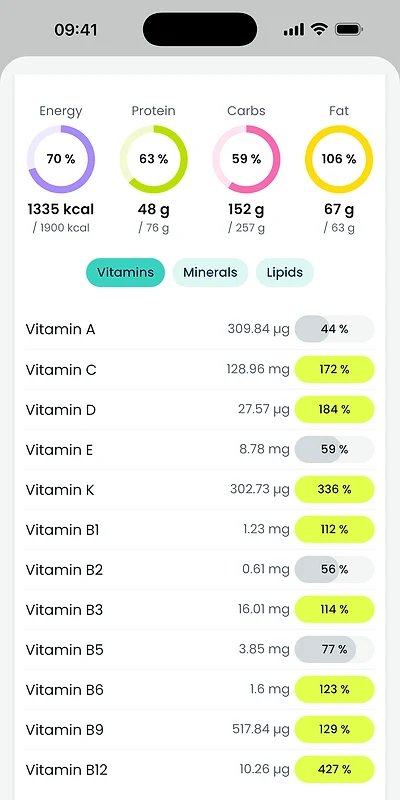
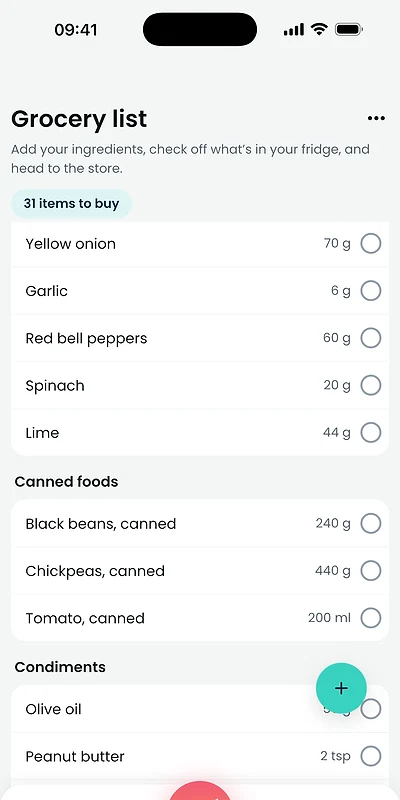
Vegochef sets your calorie and macro targets with the same formula, then helps you fill them with plant-based meals and tracks 29 vitamins, minerals and lipids.
Try it free for 7 days
Sources
- Mifflin MD, St Jeor ST et al. A new predictive equation for resting energy expenditure in healthy individuals. American Journal of Clinical Nutrition, 1990.
- Frankenfield D et al. Comparison of predictive equations for resting metabolic rate in healthy nonobese and obese adults: a systematic review. Journal of the American Dietetic Association, 2005.
- National Academies of Medicine: Dietary Reference Intakes for energy (2023).